By Alejandro Cebrián · Sunnydays Fotografía
There’s something about photographs made on film that many couples find irresistible. Perhaps it’s the grain, the way certain colors feel, or simply knowing that the picture was captured on a physical strip of film rather than only as a digital file. But popularity isn’t a particularly good reason to add analog photography to your wedding package.
I enjoy working with film because it offers a different way of seeing and photographing a scene. At Sunnydays, analog photography can complement digital coverage, giving a wedding gallery another visual texture. But I wouldn’t tell you that film is automatically more artistic, more emotional, or better than digital. Both can produce wonderful photographs, and their strengths are different.
What is film wedding photography?
Analog film photography uses light-sensitive photographic film in a camera. Each exposure creates an image that must later be chemically processed; negatives are commonly scanned to create digital files for editing, sharing, and printing. Unlike a digital camera, you cannot immediately review the final image on the back of the camera.
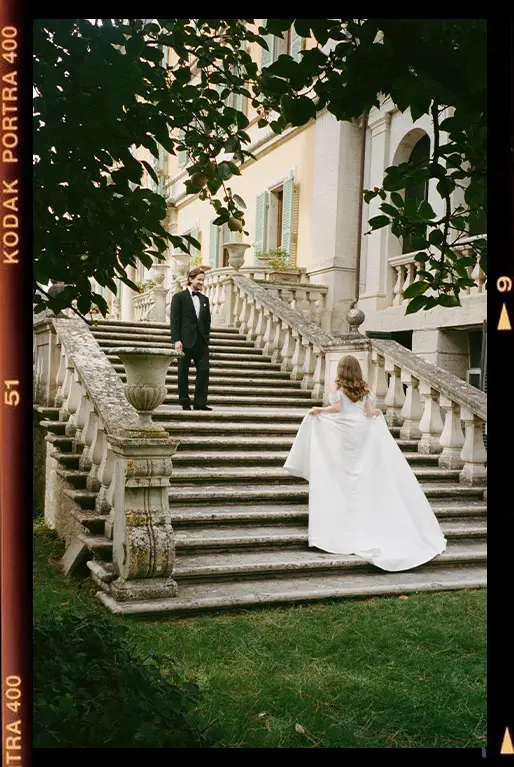
Different film formats and stocks can have different color, contrast, grain, and sensitivity characteristics. Processing and scanning also influence the finished appearance. There’s no single universal “film look,” which is why I’d recommend looking at actual film frames from the photographer you’re considering.
What does film add to a wedding gallery?
Texture and color
Some film stocks produce grain and tonal transitions that couples love. Certain color films can render skin tones and highlights in a way that feels distinctive, although the result depends on exposure, processing, scanning, and editing. It’s important not to imagine that putting a roll of film in any camera instantly creates the same soft pastel photograph you’ve seen online.
A different rhythm
With a limited number of exposures, the photographer has to think deliberately about when to press the shutter. I enjoy that change of pace for portraits, details, and moments with a little room to breathe. But it isn’t proof that every film photograph is more thoughtful than a digital one. A skilled digital photographer can work just as deliberately.
A physical original
Film produces negatives that exist independently from the scanned files. That has a particular appeal, although the negatives still need careful storage and can be damaged or lost. Ask whether the photographer retains them, returns them, or offers them separately; the answer isn’t standardized.
Where film works particularly well
I like using film selectively for getting-ready details, relaxed couple portraits, quiet interactions, and atmosphere during a daylight cocktail hour. When the light is suitable and there’s time to make considered frames, analog photography can add a lovely parallel set of images.
Film can also be beautiful for guests and family groups, but remember that people move quickly. A photographer must make choices about what to capture on limited frames. If a specific moment is absolutely unrepeatable, I would prioritize reliable digital coverage and use film as a creative complement.
Where digital has practical advantages
Digital cameras offer immediate feedback, flexible sensitivity settings, and high-volume capture without a per-frame film cost. They can be especially useful during fast-moving ceremonies, very dark receptions, and moments where several reactions happen almost simultaneously. Film can be used in difficult light by a photographer who knows how, but it often requires more deliberate technical preparation.
I wouldn’t recommend covering an entire wedding on film simply because it seems fashionable. It can be done by specialists, but it introduces additional considerations around stock, exposure limits, development, and risk. For most couples who love the aesthetic, a hybrid approach offers a sensible balance.
How many film photographs will you receive?
The answer depends on the film format, how many rolls are used, and the number of successful frames after processing. A standard 35mm roll commonly has 24 or 36 exposures, but that doesn’t mean every exposure becomes a delivered photograph. Medium-format rolls have fewer frames, and some photographs may not meet the photographer’s selection standards.
If a package includes two or four rolls, ask which format is being used and what kind of final selection to expect. I’d be wary of anyone promising a fixed number of perfect film photographs without acknowledging the possibility of exposure, processing, or scanning issues.
Film can be imperfect, and that’s part of the decision
Grain, color shifts, dust, light leaks, or slight exposure variations can sometimes contribute to the character people love. But not every technical error becomes artistic simply because it happened on film. Underexposed frames, camera problems, or processing faults can also produce disappointing results.
Your photographer should be honest about that uncertainty. If you want every image to match a precise reference and require immediate consistency, digital photography may be a better fit. If you enjoy the variation and are happy with a carefully selected analog supplement, film could be something you’ll treasure.
Can digital editing imitate film?
Digital photographs can be edited to resemble certain film characteristics, and modern cameras and software offer considerable flexibility. But a digital film-inspired edit isn’t the same process as exposing and developing film. That difference matters to some couples and not to others. I’d choose based on the final photographs you love and the experience you value, rather than treating one medium as inherently more authentic.
Likewise, film isn’t automatically timeless. An image becomes meaningful because of what it shows, how it’s made, and the memories attached to it, not simply because it has grain or a particular color palette. My guide to wedding photography styles separates the visual approach from the medium used.
What happens after the wedding?
Film usually needs to be sent for processing and scanning before it can be reviewed and incorporated into the final gallery. That can add time depending on the laboratory and workflow. Confirm whether film photographs are delivered with the digital gallery, whether any previews include film images, and whether negatives are returned.
Film scans can usually be included in a wedding album alongside digital photographs, although their resolution and appearance depend on the format and scanning method. A well-designed album can make the differences feel intentional rather than inconsistent.
Is film worth the extra cost?
If you love the analog aesthetic, enjoy its physical process, and want a small collection of images with that character, it can be a wonderful addition. If you’re mainly adding it because you’ve seen a trend on social media, I’d spend some time looking at complete film examples first. You may discover that the digital style of your favorite photographer already gives you everything you want.
Budget for the actual service: film stock, processing, scanning, and the photographer’s additional work. A quote should specify the number of rolls or coverage included, rather than using film as a vague luxury label.
Frequently asked questions
Does film replace digital wedding photography?
Not in every package. Many photographers use film as a supplement to digital coverage, which is my preferred approach for most celebrations.
Will the film photographs look exactly like the digital ones?
No. Even when edited cohesively, different media and conditions can produce visible differences in grain, color, contrast, and texture.
Can film be used at night?
Yes, with appropriate film, exposure, and often flash or other lighting. The practical approach differs from working digitally in low light.
Do we receive the negatives?
That depends on the photographer’s policy. Ask before booking if owning physical negatives matters to you.
Choose film for the photographs you love
Film is worth considering when you love the actual photographs and the character of the process, not merely the idea of something vintage. I enjoy the way it can complement a natural, editorial wedding story. If you’re curious, I can show you examples from real analog coverage and explain how it would fit into your Sunnydays collection.
For the wider planning context, see wedding photography pricing.
To see whether my approach fits your wedding, explore my photography portfolio and tell me about your date and venue.